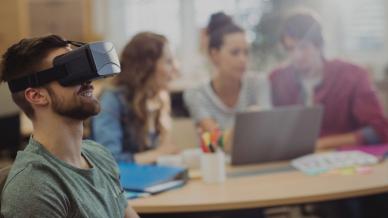
If you’re feeling worn out by traditional courses that drag on and never quite stick, you’re not alone. Research keeps confirming what trainers see every day: most learners forget new information almost as quickly as they receive it—unless the experience grabs their attention and keeps their brain switched on.
In a world that’s moving at the speed of a Silicon Valley product launch, “transferring information” is no longer enough. Today’s trainers want methods that spark curiosity, activate the senses, and make learning feel less like a chore and more like stepping into an experience.
This guide pulls back the curtain on the craft of immersive course design, revealing how Gamification and Virtual Reality (VR) can transform an ordinary training program into an unforgettable, high-engagement journey. When used effectively, these tools don’t just make learning enjoyable; they also dramatically enhance focus, retention, and real-world skill development.
Why Immersive Learning Works?
Immersive learning places trainees inside a dynamic, interactive environment that mirrors—or even surpasses—real life. Utilizing tools such as VR, AR, MR, and gamified systems, it aims to engage learners emotionally, physically, and cognitively.
Instead of passive absorption, learners are pulled directly into the experience. The result is a training environment that feels alive—more like a hands-on workshop than a lecture in disguise.
Immersive learning stands out because it offers meaningful gains in:
- Increased interaction and engagement
- Improved recall and information retention
- Development of practical, hands-on skills
- A fun and stimulating learning experience
- Safe training environments
- Enhanced critical thinking and problem-solving
Think of it as the difference between reading about swimming and actually being in the water.
Gamification: Turning Training Into a “Can’t-Put-It-Down” Experience
Gamification borrows the mechanics that make games addictive—such as points, levels, badges, and leaderboards—and embeds them into learning experiences. It doesn’t turn your course into a video game; it simply taps into the natural human desire for challenge, progress, and reward.
Done right, gamification transforms the learning journey into something that feels active, personal, and genuinely motivating.
Its impact shows up in several powerful ways:
- Stronger motivation and engagement: Turning tasks into challenges—complete with badges, levels, and streaks—naturally boosts participation.
- Better retention: Interactive tasks help learners live the content, making it stick far longer than passive listening.
- Behavioral change and skill mastery: Safe, simulated environments allow repeated practice, helping learners build confidence and refine performance.
- Healthy competition and collaboration: Leaderboards and team challenges drive both individual excellence and group cohesion.
- Meaningful data: Gamified systems generate clear insights about progress, strengths, and gaps—helping trainers tailor support.
VR & AR: Training Tools Built for the Future
Virtual Reality (VR) and Augmented Reality (AR) have become the backbone of modern immersive training. These technologies deliver experiences that traditional teaching simply cannot recreate.
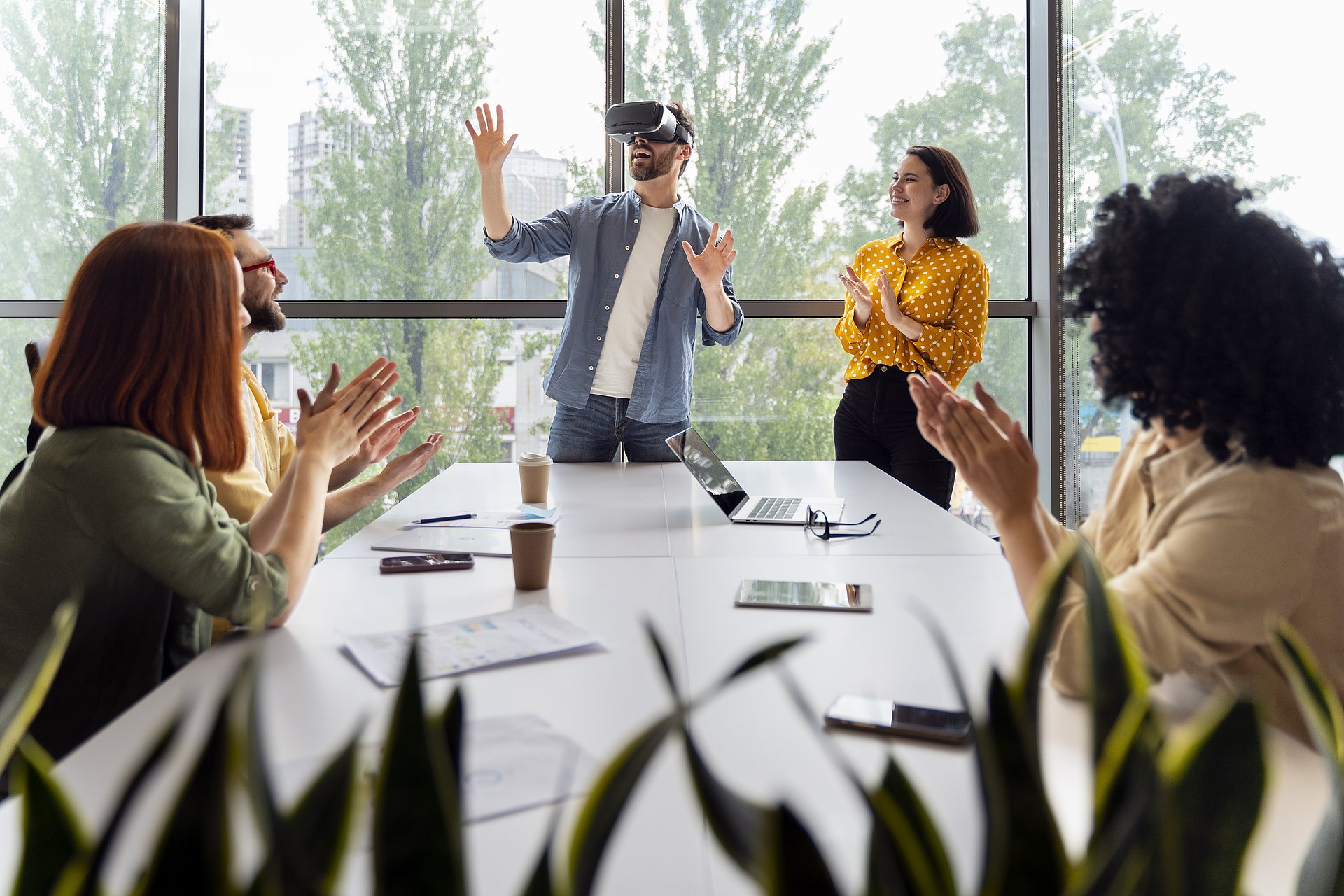
VR transports learners into a wholly digital environment—whether it’s a realistic simulation or a custom-designed world. With a headset on, the outside world fades away, replaced by a highly focused audio-visual experience.
VR brings powerful learning advantages:
- Risk-free simulation of dangerous scenarios: Surgeries, hazardous repairs, emergency responses—practiced safely and repeatedly.
- Mastery of complex tasks: High-detail environments allow precision practice that would otherwise require expensive equipment.
- Deep experiential learning: Abstract concepts become tangible—you can walk inside a human artery or fly through a physics model.
- Reduced costs and time: No physical labs or equipment needed, with faster learning cycles.
- Instant feedback: Performance data appears in real time, helping learners correct mistakes on the spot.
AR works differently. Instead of removing learners from reality, it layers digital elements—such as 3D models, text, and graphics—on top of the physical world through a phone, tablet, or smart glasses.
AR shines in practical, on-site learning:
- Real-time support on the job: Step-by-step overlays guide users through actual tasks, like maintenance or assembly.
- Context-rich learning: Because trainees practice on authentic objects, understanding deepens and retention improves.
- Clarity for complex tasks: Visual overlays help break down difficult processes and reduce errors.
- Interactive, hands-on learning: Real objects become tools for exploration—like taking apart a digital engine sitting on your desk.
- Easy adoption and scalability: AR runs on everyday smart devices, making it far easier to deploy than VR hardware.
Designing Immersive Training: A Step-by-Step Playbook for Future-Ready Learning
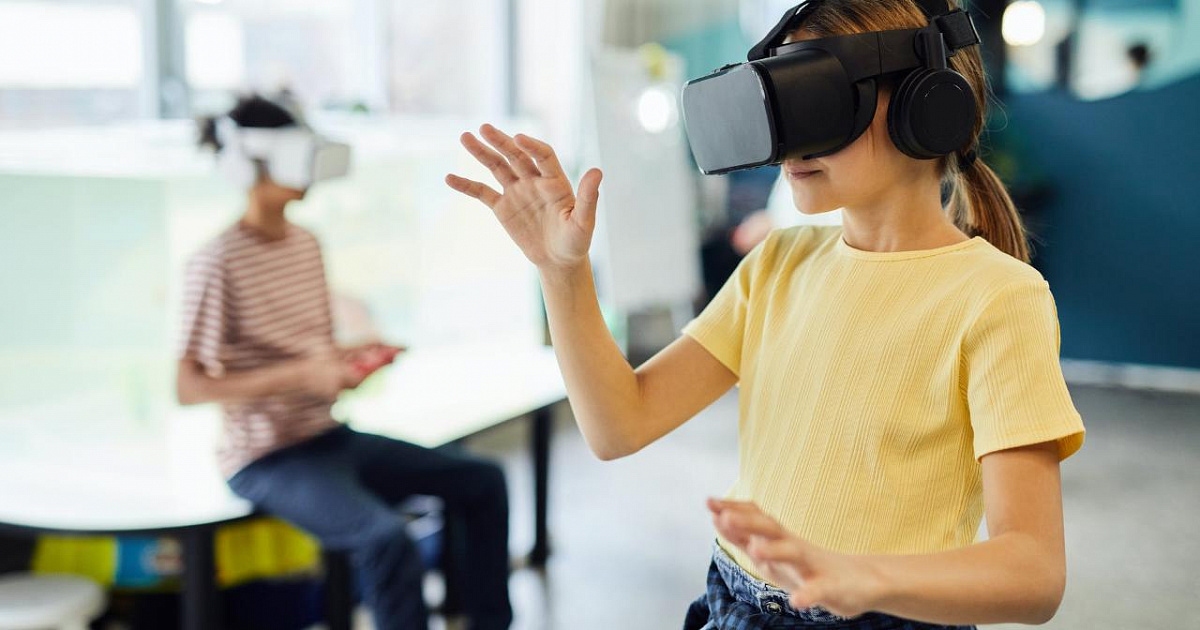
Creating an immersive training experience requires thoughtful planning that aligns learning objectives with modern technologies.
Below is a practical example: designing an immersive VR + Gamification course for “new customer service employees at a telecom company” to help them handle difficult complaints.
Phase 1: Define Learning Objectives and Desired Outcomes
- Objectives: Enabling the trainer to:
- Apply active listening techniques with 90% accuracy when dealing with angry customers
- De-escalate 70% of confrontations without supervisor intervention
- Offer at least three alternative solutions within five minutes
- Expected outcomes: Reduce escalation by 15%, boost customer satisfaction, and help new hires feel less like they’re being thrown into the deep end on day one.
Phase 2: Get to Know Your Audience—Really Know Them
- Who they are: New reps aged 20–30, tech-comfortable, but inexperienced in handling emotional customers.
- Challenges: Fear of anger, lack of problem-solving experience under pressure, and low confidence.
- Motivations: Career development, performance evaluation, mastering challenging situations.
Phase 3: Choose the Right Immersive Technologies
- Virtual Reality (VR): Perfect for simulating a busy call-center floor complete with “virtual angry customers.” VR allows trainees to experiment, fail, adjust, and try again without facing real-world consequences. They can also practice reading tone, body language, and nonverbal cues.
- Gamification: Adds energy, motivation, and a sense of forward motion—turning the whole experience into a meaningful challenge rather than a checklist.
Phase 4: Design the Scenario and Learning Content
- Create the Narrative: The program becomes a company-wide “mission” where trainees must restore the brand’s reputation after a surge of complaints. Each level introduces a more demanding customer, increasing the pressure—and the learning.
- Interactive VR Scenarios:
- Level 1: The Frustrated Customer: The customer starts with a calm tone that gradually escalates. The trainee learns active listening and empathy.
- Level 2: The Aggressive Customer: The trainee encounters a customer who becomes verbally aggressive and uses inappropriate language. They learn how to stay calm and absorb the anger.
- Level 3: The Threatening Customer: A complex scenario involving a customer who threatens to leave the company or report to authorities. The trainee learns when to escalate the issue and how to offer convincing alternative solutions.
- Gamification Elements:
- Points: Awarded based on active listening, appropriate responses, quick resolution, and calming the customer. Points are deducted for unjustified escalation or poor handling.
- Badges:
- “Listening Hero” – awarded for mastering active listening techniques.
- “Fire Extinguisher” – awarded for successfully calming angry customers.
- “Solution Genius” – awarded for offering creative solutions.
- “Performance Star” – awarded after reaching a specific total score.
- Levels: Successfully handling each customer unlocks the next (more difficult) customer.
- Leaderboard: Displays top-performing trainees in handling complex complaints, fostering friendly competition.
- Rewards: Certain levels unlock “extra tips” or “secret tricks” for dealing with customers.
- Feedback: After each VR scenario, the trainee receives a detailed report on performance, including analysis of word choice, tone of voice, and the “customer’s reaction,” along with improvement tips.
Phase 5: Development and Programming (Implementation)
- Development Tools: Using game engines like Unity 3D or Unreal Engine to build the VR environment and interactions.
- Character Design: Creating 3D models of virtual customers with realistic expressions and behaviors.
- AI Programming: Developing AI-driven customers who react realistically to trainee responses (increase anger, calm down, reject solutions, accept solutions).
- Gamification System Integration: Programming the points, badges, levels, and leaderboard systems.
Phase 6: Testing and Evaluation
- Alpha Test: Internal testing by the design team to ensure there are no technical issues.
- Beta Test: Delivering the course to a small group of experienced customer service employees and new trainees to gather feedback on usability, realism, and effectiveness.
- Feedback Collection: Using surveys and interviews after each VR session to assess the experience and measure immersion and motivation.
- Performance Evaluation: Comparing trainees’ VR performance with their later real customer interactions. Did escalation rates decrease? Did customer satisfaction improve?
- Continuous Improvement: Based on feedback and assessments, scenarios, interactions, or gamification elements are refined to enhance the course.
This example shows how each step integrates to create a powerful and effective immersive training experience, combining the simulation capabilities of VR with the motivational strength of gamification.
Building VR/AR Interactive Scenarios: A Second Example
To demonstrate how precise learning objectives can be applied in game-based training, here is a training scenario for “Performing Basic Maintenance on Industrial Equipment” using VR:
1. Define Behavioral Objectives
The main and sub-objectives are defined clearly to measure learning outcomes, such as mastering a specific task, applying safety protocols, or making correct decisions under pressure.
2. Design the Interactive Environment
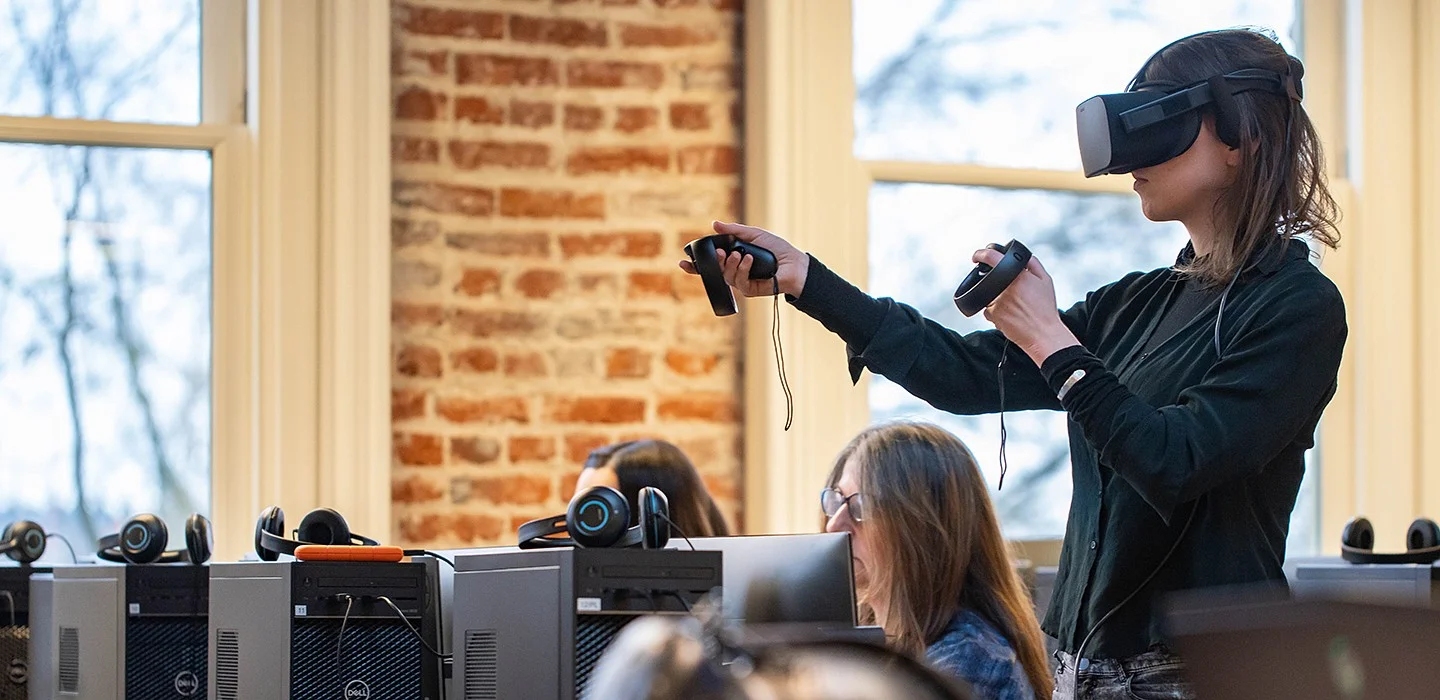
A lifelike workspace with real tools, sounds, and lighting. Trainees use controllers or AR interfaces to work hands-on.
3. Build Interactions and Decision Points
The scenario is divided into interconnected stages (preparation, execution, testing), with moments requiring instant decisions. Correct choices advance the mission, while mistakes provide learning opportunities through simulated consequences.
4. Embed Feedback Mechanisms
Immediate feedback is delivered after each step visually (via green/red indicators), audibly (through comments or alerts), and textually (with explanations of correct or incorrect actions). Errors are linked to realistic consequences to reinforce behavioral learning.
5. Challenge Progression and Gamification
Levels progress from simple tasks to more complex situations, introducing diagnostics, time pressure, or environmental distractions. Competition is encouraged through a points, badges, and levels system that helps trainees track progress.
6. Performance Tracking and Analytics
The system automatically records data (time, errors, decisions, help requests) to generate detailed reports highlighting strengths and areas for improvement. These analytics help trainers refine content based on group performance patterns.
Challenges and Practical Applications
Immersive learning holds tremendous promise for transforming training, but it also presents a set of challenges that must be addressed. At the same time, numerous practical applications demonstrate its effectiveness. Below are the key challenges and applications:
Key Challenges
- High initial cost
- Need for specialized technical expertise
- Technical/infrastructure limitations
- User comfort and adaptability
- Content quality and relevance
- Data security and privacy
Practical Applications
- Healthcare and medicine
- Manufacturing and maintenance
- Aviation and defense
- Customer service and sales
- Recruitment and onboarding
- Construction and engineering
- Safety and security training
The Future of Training Isn’t Coming. It’s Already Here
Immersive training isn’t a passing trend—it’s the new standard for anyone serious about performance, engagement, and real-world results. When you combine Gamification, VR, and AR, you’re not just upgrading a course. You’re transforming how people learn, grow, and show up at work.
Organizations that invest now won’t just stay competitive—they’ll build teams who thrive under pressure, adapt quickly, and perform at a higher level.
The question isn’t whether immersive training is worth it—it’s whether you’re ready to lead the shift.
This article was prepared by coach Adel Ebadi, an ITOT certified coach.